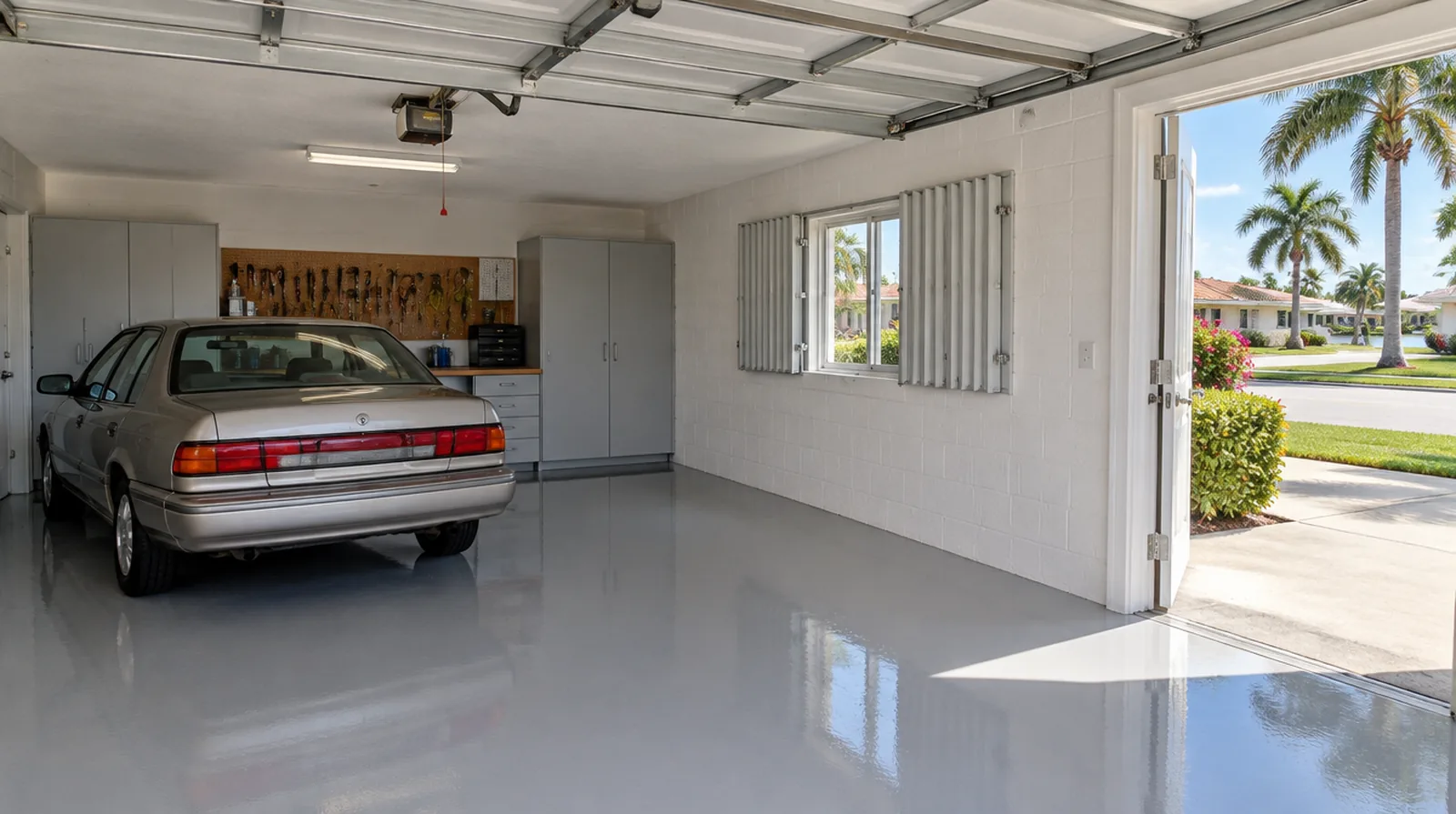
What a forty-year-old garage floor looks like
Most of the garages we see here were poured when the house was built, often decades ago. Over that time the concrete has collected oil from several generations of cars, rust rings from paint cans and patio chairs, and a coat or two of floor paint that is now worn through in the tire paths. Some floors have hairline cracks running from corner to corner. Others have a soft, dusty surface where the top layer of cement has worn away. None of that rules out a coating. It just means preparation matters more than the color you pick.
Grinding comes first
We start by removing everything on the surface. Heavy planetary grinders with diamond tooling take off old paint, sealers and stains, along with the weak top layer of concrete. The grinders are connected to industrial vacuums, so dust is captured rather than drifting across the driveway or into the house. Edges along walls, around water heaters and at the step into the home are ground by hand. When we are finished, the slab has a clean, open texture that primer can soak into.
Acid etching and pressure washing do not do the same job. They clean the surface but leave paint and weak concrete in place, which is why so many store-bought coatings peel within a year or two.
Crack and joint repair
After grinding, every crack becomes easy to see. Fine shrinkage cracks are filled with a rigid epoxy filler. Wider cracks are cut open slightly and filled so the repair locks in. Spalled areas near the door, where water and salt air have eaten into the surface, are rebuilt with a repair mortar. Control joints can be filled for a smooth look or left open if the slab still moves. We tell you which approach we recommend and why.
The coating system
Primer
A thin, penetrating primer bonds to the ground concrete. Where moisture readings are high, which is common in older slabs without a vapor barrier, we use a moisture-tolerant primer instead.
Body coat
A thick pigmented epoxy layer gives the floor its color and build. Light gray, tan and white are popular because they brighten a garage with only one small window.
Topcoat
A clear polyaspartic or urethane topcoat seals everything in. These topcoats resist yellowing in sunlight and stand up to hot tires better than plain epoxy.
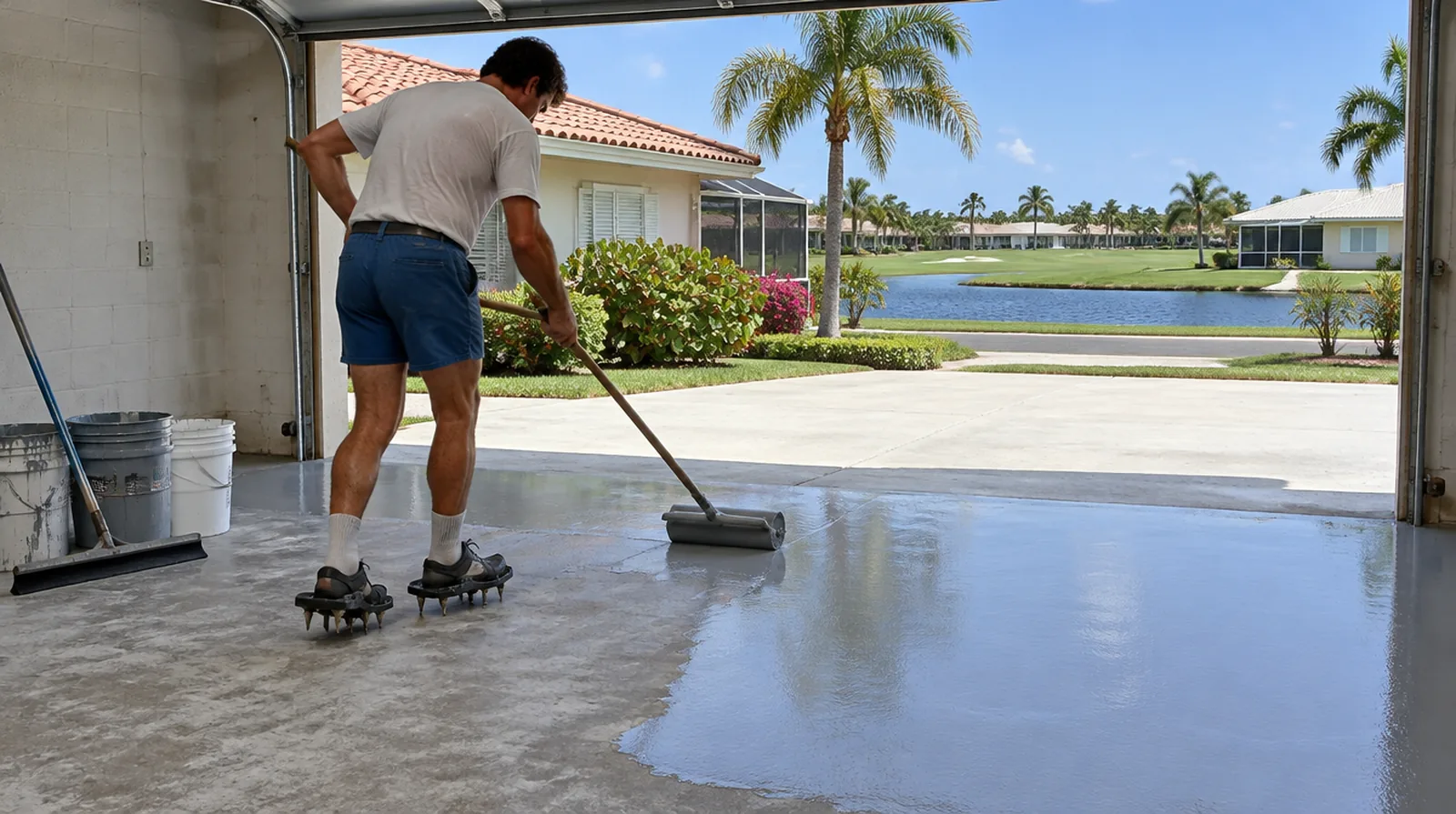
Hot tires and summer heat
Driving home on a July afternoon heats tires enough to soften weak coatings. When the car sits and cools, the rubber grips the floor. When you back out, a poorly bonded coating can lift right off. Real grinding, proper film thickness and a hard topcoat prevent that. We regularly replace kit floors with tire-shaped bare patches, and the fix is always better preparation.
Garages that do double duty
Here, the garage is often also the laundry room, the hurricane supply closet and the place where the golf cart charges overnight. Washers leak, detergent spills and charging carts drip battery water. We can coat the laundry area and any storage closets in the same system, and we use chemical-resistant topcoats where battery acid or pool chemicals are stored.
Scheduling and cure times
The garage needs to be empty before we start. Most two-car floors take one or two days. You can usually walk on the floor the next day, put things back a day later and drive on it after about 72 hours for full epoxy systems. Polyaspartic systems shorten that considerably. In summer, we start early so materials go down before the garage heats up.
Care and cleaning
Sweep or blow off grit and grass clippings regularly. For deeper cleaning, use a soft mop with a mild cleaner and rinse well. Avoid acidic cleaners and harsh degreasers. Put pads under motorcycle kickstands and jack stands, and wipe up brake fluid or battery acid promptly.
Common questions
Can you coat over my old floor paint?
No. We remove it completely, because new coating will only hold as well as the paint underneath.
Will the floor be slippery?
We add a fine anti-slip aggregate to the topcoat, which keeps footing secure when the floor is wet.
Do you coat the step into the house?
Yes. The step face and tread are included so the whole space looks finished.
Book a garage estimate
Contact us to schedule a visit, or compare options on our flake flooring page.
Get a garage floor quote
Call (954) 280-5619 for a free estimate.